
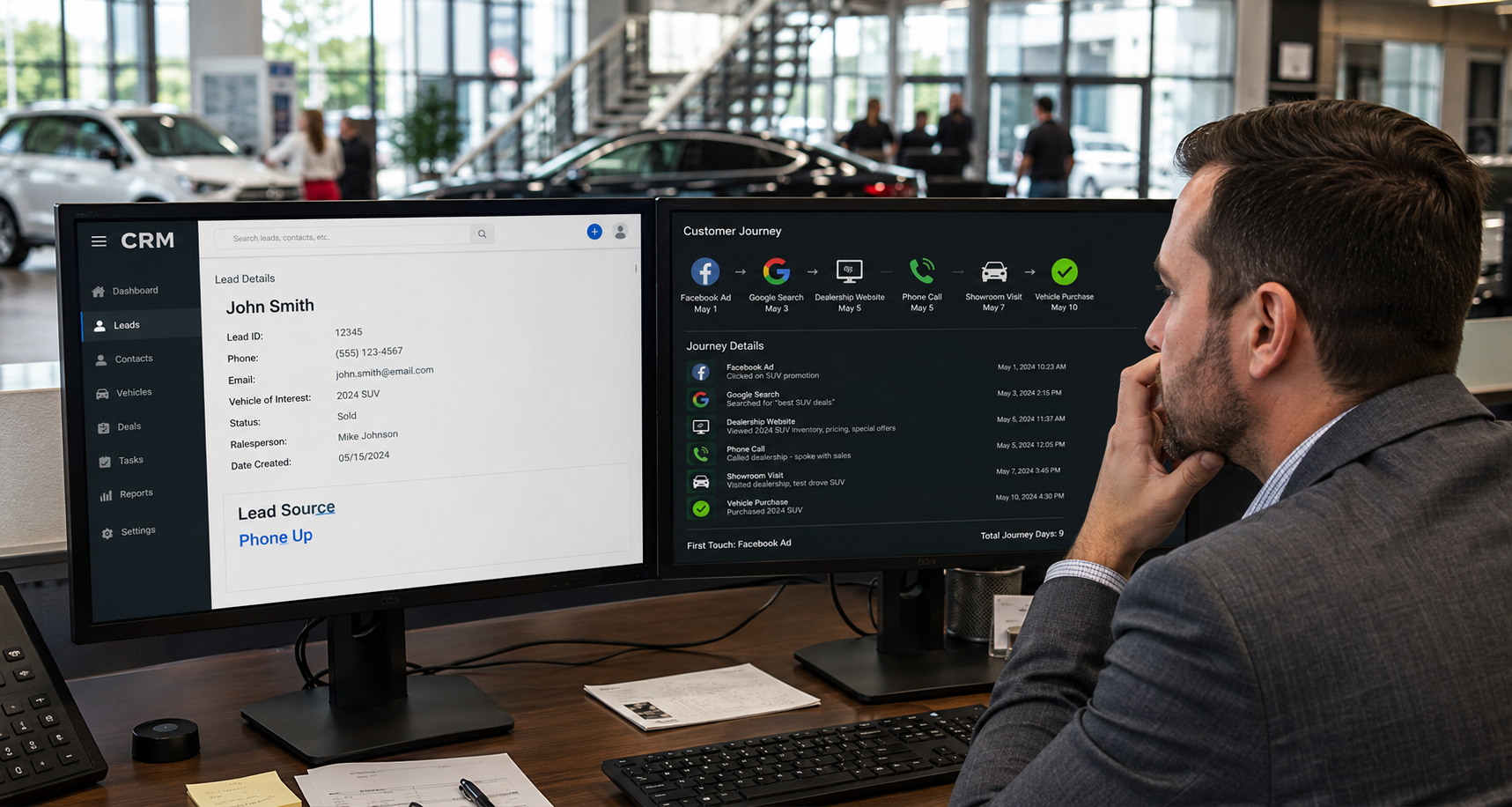
It sounds like a simple question. Where did this lead come from? But dealership managers who have tried to answer it honestly know how quickly the answer falls apart.
The CRM says one thing. The vendor report says another. The salesperson remembers the customer mentioning something completely different. And the customer themselves, if you asked them right now, could probably tell you exactly what brought them in — but nobody thought to ask.
The most accurate source of information about where a customer came from is the customer. Everything else is an estimate.
Why Lead Source Tracking Is Harder Than It Looks
Most dealerships have systems in place that are supposed to track lead sources. The CRM records where a form was submitted. Call tracking software logs which number was dialed. Google Analytics reports which channel drove a website visit.
Each of these tools does exactly what it is designed to do. The problem is that none of them were designed to answer the full question. They each capture one moment in a customer journey that may have included five, six, or ten different touchpoints before the customer ever set foot on the lot.
A customer who submits a lead through a third-party listing site may have first heard about the dealership on the radio during their morning commute. They may have driven past the lot three times before searching online. They may have gotten a recommendation from a coworker before doing any of that. The lead source field in the CRM records the last click. It does not record any of the rest.
The Vendor Credit Problem
Making this harder is the fact that vendors have a natural incentive to claim as much credit as possible for the leads they report. Every advertising platform — search, social, listings, display — has its own attribution model, and most of those models are designed to show that platform in the best possible light.
When a dealership receives reports from four different vendors and adds up the leads each one claims, the total often exceeds the actual number of customers who came through the door. Every vendor counted the same customer. Every vendor claimed the sale.
This is not necessarily dishonest. It is a reflection of how multi-touch attribution works when every platform measures itself in isolation. But it means the dealership cannot trust any single vendor report to give them an accurate picture of what actually drove a purchase.
What the CRM Gets Right and What It Misses
CRM systems are essential tools for managing the sales process. They organize leads, track follow-up, and give managers visibility into pipeline activity. That is what they were built for.
But CRM lead source fields were built as an organizational convenience, not as a marketing measurement tool. They are often filled in manually by whoever enters the lead, and the options available in a dropdown menu rarely reflect the full range of ways a customer might have discovered the dealership.
A customer who drove by the dealership every day for a month before coming in will likely be recorded as a walk-in. A customer who heard about a sale on the radio and searched by name before submitting a form online may be recorded as organic search. The real story behind each of those customers is more nuanced than the CRM field can capture.
Digital Tracking Alone Does Not Tell the Full Story
Digital attribution tools have become increasingly sophisticated, and they do provide useful data about online customer behavior. But vehicle purchases are not purely digital decisions, and digital tracking cannot measure what happens offline.
Television, radio, direct mail, signage, word of mouth, and repeat customer relationships all influence buying decisions at dealerships. None of those channels leave a digital footprint that attribution software can follow.
A dealership that relies entirely on digital attribution is measuring part of the picture and making budget decisions as if it were the whole thing. Channels that do not produce trackable clicks look like they are not working, even when they are driving customers through the door every week.
The Most Reliable Method: Asking the Customer Directly
When a customer has just signed paperwork and completed a vehicle purchase, they can tell you exactly what brought them in. The experience is fresh. They are engaged. And the question of where they heard about the dealership is a natural part of the conversation.
Capturing that answer consistently — across every sold customer, at every rooftop, every month — produces a data set that no CRM report or vendor dashboard can replicate. It is source information confirmed by the person whose opinion is the only one that actually matters.
This is the foundation of dealership marketing attribution software built around the point of sale. Instead of inferring where customers came from based on digital signals and vendor claims, the dealership captures it directly from sold customers at the moment of purchase.
What Point-of-Sale Attribution Reveals
When dealerships start collecting source information from sold customers at the finance office, the data they get back often surprises them. Sources they assumed were underperforming turn out to be consistently driving real buyers. Channels they were spending heavily on show up infrequently in sold customer responses.
Repeat customers and word-of-mouth referrals — sources that digital tracking almost never captures accurately — frequently show up as the strongest performers when sold customers are asked directly. That is information that changes how a dealership thinks about customer retention and referral programs, not just paid advertising.
Automotive marketing attribution that starts with the sold customer also allows dealerships to connect source data to gross profit. Not just which sources drive traffic, but which sources drive the most profitable deals. That distinction is what separates useful marketing data from truly actionable marketing intelligence.
Multi-Source Attribution: Customers Do Not Come From One Place
One of the most important things point-of-sale surveys reveal is that customers rarely credit just one source. A buyer might say they saw a Facebook ad, heard the dealership mentioned by a friend, and then drove by the lot before deciding to come in. All three of those things contributed to the sale.
Forcing every customer into a single source box produces clean reports but inaccurate data. A system that captures multiple sources per customer gives a more honest picture of how advertising channels work together — and which combinations consistently appear in the histories of sold customers.
Dealer source tracking that allows for multi-source responses reflects the reality of how customers actually make decisions, rather than the simplified version that fits neatly into a CRM dropdown.
Connecting Source Data to Gross Profit
Volume is one measure of a marketing source. Profitability is a better one. A source that consistently brings in buyers who negotiate hard and produce low front-end gross may be less valuable than a source with lower volume but stronger average gross per deal.
Dealership ROI tracking that connects source data to front gross, back gross, and total gross per deal gives management a complete picture of what each advertising channel is actually worth. That is the number that should be driving budget conversations with vendors — not impressions, not clicks, not leads, but gross profit per sold customer by source.
How ReferralTrace Answers the Question
ReferralTrace was built specifically to answer the question that dealerships have been asking for years. How do you know where a lead — and more importantly, a sale — actually came from?
The process starts in the finance office. After a deal is completed, the finance manager hands the customer a simple survey on an iPad. The customer selects the sources that influenced their decision to visit and purchase. That response is tied directly to the deal and the gross profit associated with it.
The result is a dashboard that shows dealership management exactly which sources are producing sold customers, which sources are producing the most profitable deals, and how performance compares across multiple rooftops — all based on confirmed customer responses rather than vendor estimates or digital inferences.
It does not replace CRM data or digital analytics. It completes the picture that those tools cannot finish on their own.
The Question Dealers Should Be Asking Every Month
The right question is not how many leads came in this month. It is how many sold customers said a particular source influenced their decision — and how much gross profit those customers produced.
That question is harder to answer with traditional tools. But it is the only question that connects marketing activity directly to dealership revenue. And when dealerships start answering it consistently, the clarity it produces changes how they spend, how they evaluate vendors, and how they think about growth.
Knowing where a lead came from starts with asking the right person at the right moment. The customer who just bought a car from you knows exactly what brought them in. The only question is whether your dealership has a system in place to capture that answer every single time.
Find out where your sold customers are really coming from.
ReferralTrace captures customer-confirmed source data at the point of sale and connects it directly to gross profit — so you always know what your advertising is actually producing.
Contact ReferralTrace