
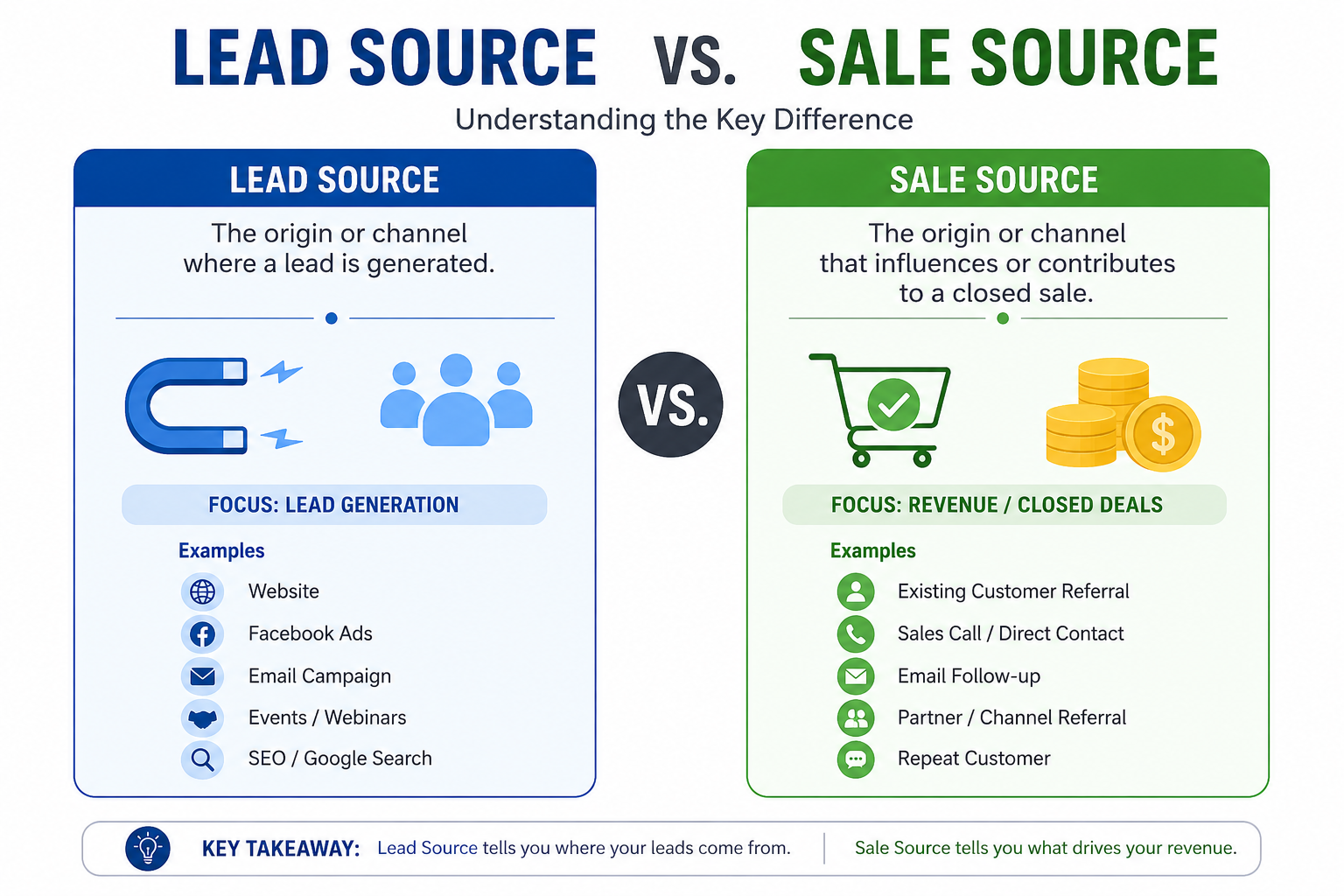
Ask most dealership managers where their leads come from, and they can give a quick answer. The CRM has a source field. The vendor reports show form submissions and phone calls. The numbers are right there.
But ask where the sales came from, and the answer gets harder. Because a lead source and a sale source are not always the same thing — and treating them as if they are is one of the most common and costly mistakes in dealership marketing.
A lead tells you where a customer raised their hand. A sale tells you what actually convinced them to buy. Those two things can point to very different places.
What a Lead Source Actually Captures
When a customer submits a form, calls the store, or chats online, the CRM typically records where that action happened. That is the lead source. It might say the customer came from a third-party listing site, the dealership website, or a paid search campaign.
That information is useful. But it only captures the moment the customer took action. It does not capture what moved them to take that action in the first place.
A customer who submits a lead from a third-party listing site may have first seen a display ad, then heard about the dealership from a coworker, then searched by name before finding that listing. The lead source only records the last step.
What a Sale Source Actually Means
A sale source is connected to the customer who actually purchased. It reflects the marketing that influenced a real transaction — not just a form fill or a phone inquiry that never went anywhere.
This distinction matters more than most dealers realize. Dealerships receive leads from many sources, but the close rate is not the same across all of them. A vendor that generates a high volume of leads with a low close rate may look productive in a standard report. A vendor that generates fewer leads with a high close rate may look weak by comparison.
When budget decisions are made based on lead counts instead of sold customers, good marketing gets cut and underperforming marketing gets rewarded.
The Gap Between Leads and Sales Is Where Budgets Go Wrong
Imagine a dealership running three advertising sources. Source A generates 80 leads per month. Source B generates 30 leads per month. Source C generates 20 leads per month.
If management looks only at lead volume, Source A appears to be the strongest performer and the safest place to invest. But if the same data is tied back to sold customers, the picture may look completely different. Source B may have the highest close rate. Source C may be connected to buyers with stronger gross profit.
Without connecting leads to actual sales, the dealership cannot see that picture. They are making advertising decisions with incomplete information.
How Customers Actually Make Buying Decisions
Vehicle buyers do not move in straight lines. A customer may become aware of a dealership through one channel, do research through another, and eventually submit a lead through a third. The lead source records that third step. The sale source should reflect the full story.
This is why dealership marketing attribution software is built to connect customer activity across the buying process — not just at the moment a lead is created, but all the way through to the point of sale.
When the full journey is captured, the dealership can see which sources consistently produce sold customers and which sources produce leads that rarely close. That is a fundamentally different level of insight than a standard CRM report provides.
Why CRM Lead Source Fields Are Not Enough
CRM platforms are valuable tools, but most were designed to manage the sales process, not to analyze marketing performance at the depth dealerships now need.
Lead source fields are often filled in manually, inconsistently, or defaulted to whatever was entered at the time of lead creation. They may not reflect the actual customer conversation. They almost never capture what the customer said when they walked into the showroom.
A more complete approach to automotive marketing attribution captures source information at the point of sale — directly from the sold customer — and connects it back to the advertising channels the dealership is actually running.
What Happens When Dealers Measure the Right Thing
When a dealership starts connecting marketing sources to sold customers instead of just leads, several things tend to happen quickly.
Some vendors that appeared to underperform suddenly show a strong connection to real buyers. Others that looked like top performers reveal a high lead volume but a weak close rate. The dealership discovers it has been spending money based on activity rather than outcomes.
That clarity changes how management evaluates vendors, how they plan budget cycles, and how they have conversations with advertising partners. It also gives dealers the confidence to make changes they may have been hesitant to make without solid data behind them.
This is the practical value of dealership ROI tracking tied to actual sales — not estimates, not projections, but real sold customer data connected to real marketing sources.
Asking the Right Questions at the Point of Sale
One of the most reliable ways to understand what drove a sale is to ask the customer directly. What made them choose this dealership? What did they see, hear, or experience that brought them in?
Those conversations happen at every dealership, but the answers are rarely captured in a consistent way. When they are, they become some of the most valuable marketing data a dealership can collect.
Dealer source tracking that captures customer responses at the point of sale gives management a clearer line from advertising spend to vehicle sales than any lead report can provide.
ReferralTrace Connects the Lead to the Sale
ReferralTrace helps dealerships bridge the gap between where leads appear to come from and where sales are actually coming from. By capturing source information at the point of sale and connecting it to sold customer activity, dealers gain a more accurate view of what their advertising is really producing.
That view changes the quality of every marketing decision that follows — which vendors to keep, which to cut, which markets to invest in, and where the best opportunities for growth actually are.
The Number That Actually Matters
Lead volume is easy to measure. It fills dashboards and vendor reports and monthly summaries. But lead volume is not the number that pays the bills.
Sold customers are the number that matters. And when dealerships build their marketing strategy around sold customer data instead of lead source data, they stop chasing activity and start chasing results.
Knowing where a lead came from is a starting point. Knowing where a sale came from is where smarter marketing begins.
Stop measuring leads. Start measuring sales.
ReferralTrace connects your marketing sources to sold customer data so you can make advertising decisions based on real outcomes — not just lead counts.
Contact ReferralTrace