Every dealership using automotive lead management software gets a source report. Every month it shows the same thing: which platform the customer was on when they hit submit. AutoTrader. Cars.com. Google. The dealership website. The report looks clean. The numbers add up. And the budget decisions that follow are often completely wrong.
The problem is not the software. The problem is what the software is measuring. Lead management platforms are built to capture the moment a customer raises their hand — the form fill, the phone call, the chat submission. They are very good at that. What they are not built to capture is everything that happened before that moment: the ads that created awareness, the websites that built trust, the referrals that sent the customer your way in the first place.
When dealerships use lead submission data to decide which vendors deserve budget, they are handing out grades based on the last ten seconds of a journey that took weeks. The vendor who happened to be standing at the finish line gets all the credit. The vendors who actually ran the race get nothing.
👉 Automotive lead management software tells you where the customer submitted. ReferralTrace tells you what actually made them buy. Those are two very different answers — and only one of them should drive your budget decisions.
What Automotive Lead Management Software Actually Tracks
To understand the attribution gap, it helps to understand exactly what lead management software is designed to do. At its core, automotive lead management software does three things well:
- Captures inbound leads from forms, phone calls, chats, and third-party platforms
- Routes those leads to the right salesperson or BDC agent for follow-up
- Tracks response times and follow-up activity against each lead
These are genuinely valuable functions. Good lead management software makes sure no lead falls through the cracks and that follow-up happens fast. Nobody is arguing against that.
But when it comes to attribution — understanding why that lead arrived in the first place — lead management software has a structural blind spot. It can only record what it can see. And what it can see is limited to the digital touchpoint the customer used to make contact.
The Moment the Data Cuts Off
The instant a customer submits a lead, the software timestamps it, tags the source, and closes the attribution question. Source: AutoTrader. Source: Google Organic. Source: Dealership Website. Done. Every earlier influence — every ad seen, every review read, every conversation that nudged them closer — disappears from the record.
⚠ The source your lead management software records is almost never the source that created the buyer. It is only the source that received the submission. These are rarely the same thing.
The Vendors Being Shortchanged Right Now
Last-touch lead attribution does not hurt all vendors equally. Some vendors sit naturally at the end of the buyer journey — branded search, the dealership website, direct traffic. Those vendors get over-credited because the customer often lands there last before submitting.
Other vendors do the heavy lifting earlier in the journey — creating awareness, building consideration, and establishing trust — but rarely receive the final lead submission. These vendors get systematically underpaid.
📊 Vendors Most Often Underpaid by Last-Touch Attribution
Social Media Advertising
Facebook, Instagram, and TikTok ads create the first moment of awareness for a huge percentage of automotive shoppers. But those shoppers rarely click and submit immediately — they browse, research, and return days later through a different channel. The social ad that started the journey gets zero credit in last-touch reporting.
Third-Party Listing Sites
Sites like Cars.com, AutoTrader, and CarGurus often receive leads directly — but they also drive enormous numbers of shoppers who compare inventory there and then submit directly on the dealership website. That dealership website lead gets the attribution. The listing site that sent the buyer gets nothing.
YouTube and Video Advertising
Video content is one of the most powerful trust-builders in the car buying journey. Buyers watch model reviews, dealership tours, and comparison videos that lock in their purchase decision — then search the dealership by name and submit a lead. The video that converted them gets no credit whatsoever.
Radio and Traditional Media
A customer hears a radio ad, remembers the dealership name, searches Google a week later, and submits a lead. Google Organic gets the attribution. The radio campaign that created the intention to buy is invisible in every lead report the dealership sees.
Referral Sources and Word of Mouth
A friend recommends your dealership. The buyer looks you up online and submits through your website. The CRM shows: Source — Direct. The person who sent you a sold customer gets no recognition, no tracking, and no appreciation in your marketing report.
Every one of these vendors may be influencing a significant portion of your sold customers. Your automotive lead management software cannot tell you that — because it only records the last door the buyer walked through, not every sign that pointed them to your dealership.
What This Blind Spot Actually Costs Dealerships
The attribution gap is not just a reporting inconvenience. It has real financial consequences for dealerships that make budget decisions based on last-touch lead data.
📊 The Attribution Gap in Action
Same 80 sold customers. Two completely different budget decisions depending on which report you trust.
What Lead Software Shows
✖ Facebook and Radio look useless. AutoTrader looks weak. Budget gets cut.
What Sold Customer Attribution Shows
✔ Facebook and Referrals are your top performers. AutoTrader punches above its lead count. Budget goes where it should.
In this scenario, a dealership relying only on lead management data would cut Facebook advertising — one of its most influential channels — and double down on its website and Google, which are capturing the buyers that other sources already created. The budget decision feels rational. The data supports it. And it is completely backwards.
Why Better Lead Management Software Cannot Fix This Problem
It is tempting to think the solution is more sophisticated automotive lead management software — better tracking pixels, cross-device identity resolution, longer attribution windows. These tools help at the margins, but they cannot solve the fundamental problem.
Digital tracking can only follow a customer where cookies and sessions allow. It cannot follow them into a conversation with a friend. It cannot track the radio ad they heard on the way to work. It cannot record the moment they watched a YouTube review on their TV and decided this was the vehicle they wanted. It cannot capture the service advisor relationship that made them loyal to your dealership before they ever submitted a lead.
These are human influences. And the only reliable way to capture human influences is to ask the humans they influenced.
👤 The buyer is the only person who knows the full story of their purchase decision. Sold customer attribution gives that story a place in your marketing report for the first time.
How ReferralTrace Makes Lead Reports More Intelligent
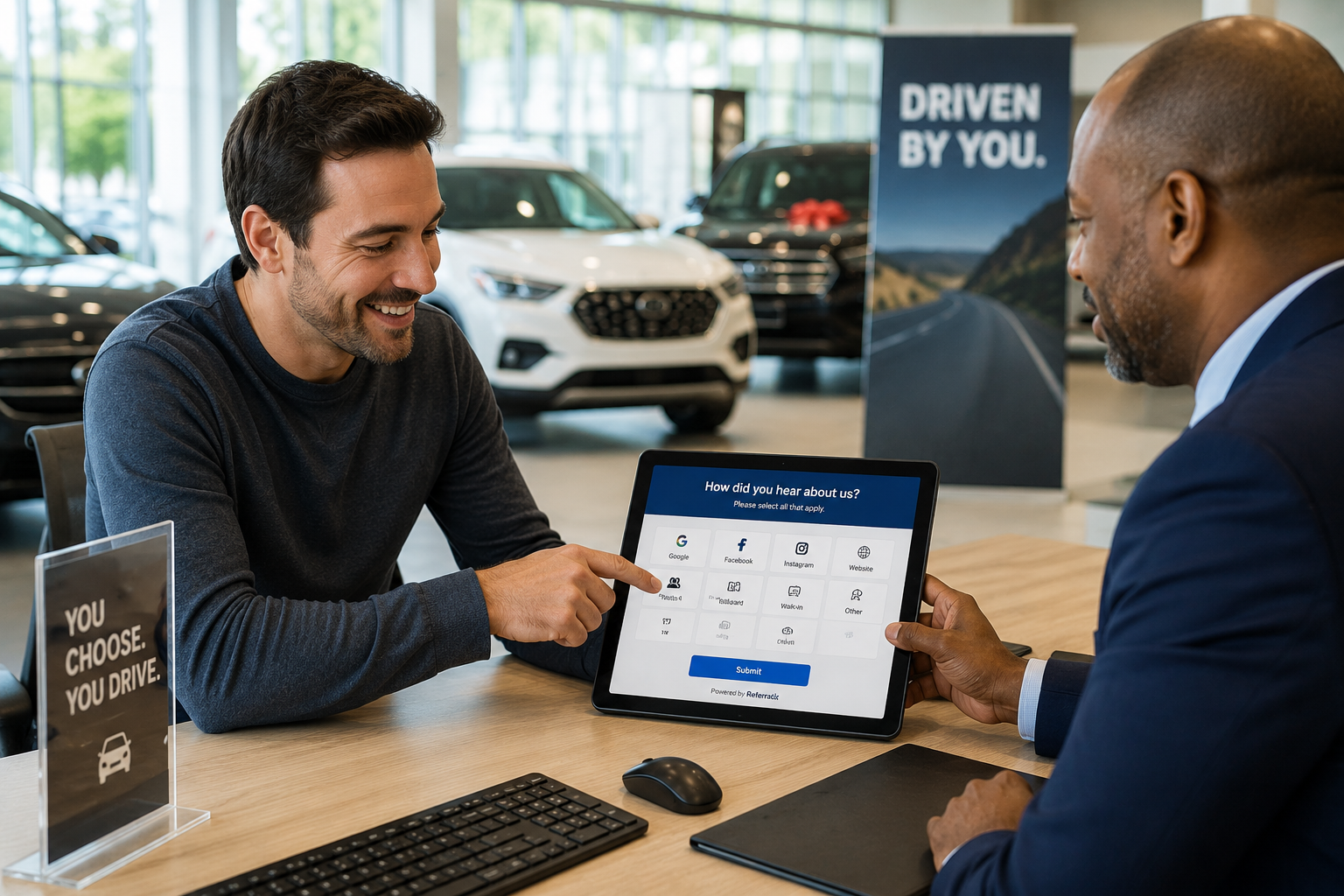
ReferralTrace was built to add the layer that automotive lead management software cannot provide on its own: sold customer attribution. Instead of asking where the lead came from, ReferralTrace asks sold customers what influenced their decision to buy.
The process works alongside your existing lead management system without replacing it. Your CRM still captures every lead the way it always has. ReferralTrace adds a structured attribution step at the point of sale — collecting customer-reported influence data and connecting it to real deal records.
What ReferralTrace Captures That Lead Software Misses
| Attribution Data Point | Lead Management Software | ReferralTrace |
|---|---|---|
| Where the customer submitted their lead | Captured accurately | Captured accurately |
| What first made the customer aware of your dealership | Not tracked | Captured from the buyer directly |
| Which sources influenced the purchase decision | Last touch only | All sources the buyer remembers |
| Word-of-mouth and referral attribution | Shows as Direct or Website | Identified and recorded correctly |
| Offline media influence (radio, TV, billboard) | Invisible to digital tracking | Captured if the buyer mentions it |
| Gross profit connected to each influence source | Rarely available | Connected to deal-level data |
| Vendor influence rate among sold customers | Not calculable | Calculated automatically |
The result is a marketing intelligence report that is built on real buyers, not just lead submissions. Instead of asking your vendors to prove their value with impressions and click data, you can now ask them a much harder and more important question: how many of my sold customers said you influenced them?
How This Changes Vendor Conversations Permanently
When a vendor comes in for their monthly review, the standard conversation looks like this: the vendor presents their lead count, their cost per lead, their impression share, and their click-through rate. The dealership compares it to last month. Everyone debates whether the numbers are good or bad. The vendor says they are good. The dealership is not sure. The contract gets renewed by default.
When a dealership has ReferralTrace attribution data, that conversation changes completely.
Now the dealership brings the data. Here is how many of our sold customers last quarter mentioned your platform as an influence. Here is the gross profit those customers generated. Here is your influence rate compared to every other vendor in our marketing mix. Here is what we paid you per influenced sold customer versus what we paid everyone else.
That is a conversation where the dealership is in control — because the dealership has the only number that cannot be spun: real buyers who credited the source with helping them make their decision.
⚠ Every vendor has a report that makes them look valuable. ReferralTrace gives dealerships the independent attribution data to verify which vendors actually are — based on sold customers, not vendor-provided metrics.
Adding Intelligence to Your Existing Lead Management Process
Getting started with sold customer attribution does not require replacing your automotive lead management software or rebuilding your CRM workflows. ReferralTrace is designed to layer on top of what you already have.
Keep your lead management software exactly as it is
Your existing system continues capturing leads, routing them, and tracking follow-up the same way it always has. ReferralTrace does not touch that workflow.
Add the attribution step at point of sale
When a customer buys, ReferralTrace captures their source influence data through a simple, structured process. The customer is asked what they saw, where they looked, and what helped them decide. It takes minutes and produces the most valuable marketing data your dealership will ever collect.
Connect influence data to deal records
Each attribution response is linked to the customer's deal — stock number, vehicle, gross profit, and zip code. Now you can see not just which vendors influenced buyers, but which vendors influenced your most profitable buyers.
Compare influence data against your lead reports
Set your standard lead source report next to your ReferralTrace influence report. The differences between them reveal exactly which vendors are being over-credited and which ones are being shortchanged — and by how much.
Make budget decisions on influence, not just lead volume
Use sold customer influence rate alongside cost per lead to calculate a true cost per influenced sold customer for every vendor. That number tells you more about marketing ROI than any metric your lead management software can produce on its own.
The Report Your Marketing Budget Has Always Needed
Automotive lead management software is not going away — and it should not. Capturing, routing, and following up on leads efficiently is fundamental to dealership operations. The problem has never been that lead management software exists. The problem is that dealerships have been using lead submission data to answer a question that lead submission data cannot answer: which vendors actually created buyers?
ReferralTrace does not compete with your lead management platform. It completes it. It adds the one data layer that turns a lead source report into a genuine marketing intelligence tool — one built on real sold customers, real influence, and real answers to the question that every marketing budget decision should be based on.
The vendor who influenced 34 sold customers deserves to know that. More importantly, you deserve to know it before you decide whether to renew their contract.
See which vendors are really driving your sold customers.
ReferralTrace adds sold customer attribution to your existing lead management process — revealing the real influence behind every deal and giving your marketing budget the intelligence it has always been missing.
Talk to ReferralTrace →