
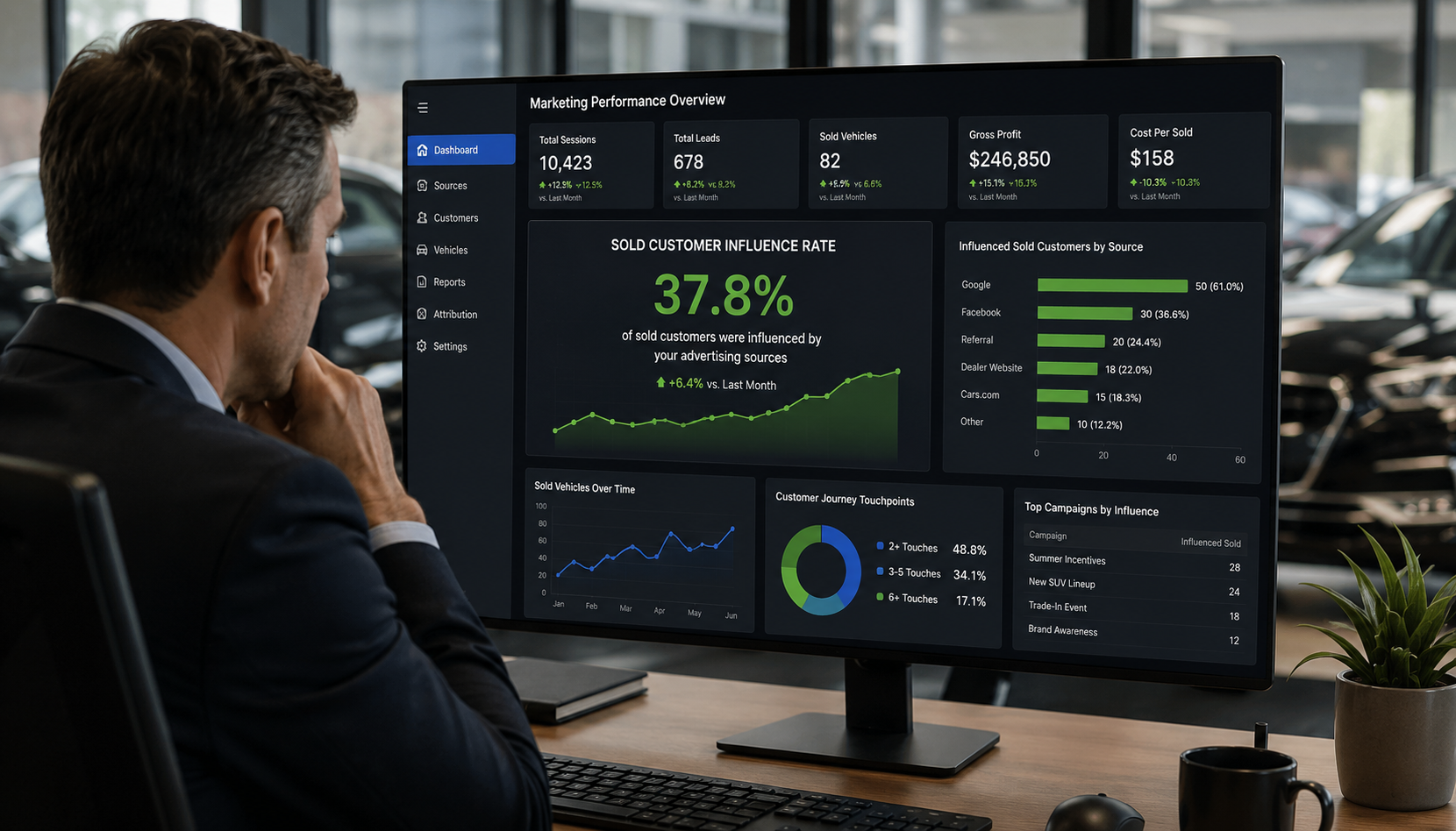
Most dealerships are not short on marketing reports. Every month, managers review website traffic, phone calls, form fills, lead counts, cost per lead, cost per click, vehicle detail page views, appointment activity, and CRM source reports.
Those numbers can be helpful. But they do not always answer the question that matters most.
Which advertising sources actually influenced sold customers?
The dealership KPI nobody is tracking is sold customer influence.
Dealerships Track Activity, Not Always Influence
A click is activity. A website session is activity. A lead submission is activity. Even a phone call is still only activity until it connects to a real sale.
The problem is that many dealerships judge advertising vendors based on activity numbers alone. A source that creates a lot of traffic may look strong. A source that creates fewer leads may look weak. But neither number proves whether that source helped sell vehicles.
Good dealership ROI tracking should go beyond activity. It should help management understand which sources influenced actual buyers.
The Missing KPI: Sold Customer Influence Rate
Sold Customer Influence Rate measures how often a marketing source is mentioned by customers who actually bought. Instead of asking only where a lead came from, the dealership asks what influenced the customer's decision.
The idea is simple:
Sold Customer Influence Rate = Sold customers influenced by a source ÷ Total sold customers surveyed
This KPI gives the dealership a clearer view of advertising performance because it starts with the customer who completed the buying process.
Why Lead Counts Can Be Misleading
Imagine one advertising source generated 1,500 website sessions and 200 leads. Another source generated 500 sessions and 40 leads.
At first glance, the first source looks better.
But what if sold customer attribution shows the first source influenced 8 sold customers, while the second source influenced 22 sold customers?
Now the story changes completely.
The first source created more activity. The second source created more buyer influence. Without sold customer attribution, management may reward the wrong source and cut the right one.
The CRM Usually Credits the Final Step
A CRM is important, but it often captures the last action, not the full journey. A shopper may see a vehicle on Facebook, compare it on a third-party listing site, search the dealership on Google, visit the website, and then submit a lead.
In that case, the CRM may credit Google or the website. But that does not mean Facebook or the third-party site had no influence.
This is why last-source reporting can create dangerous marketing decisions. It gives credit to the final touch while ignoring the sources that helped create demand earlier.
Customer Attribution Adds the Missing Layer
Customer-reported attribution gives dealerships another layer of truth. It does not replace the CRM. It completes the CRM.
The CRM shows what was captured digitally. The customer explains what they remember, what influenced them, and what helped move them toward the purchase.
This is where dealership marketing attribution software becomes valuable. It gives the dealership a process to collect source influence directly from sold customers.
Why This KPI Matters to General Managers
General managers do not need another report full of noise. They need a cleaner way to decide which vendors deserve budget, which campaigns deserve attention, and which sources are creating real buyers.
Sold Customer Influence Rate helps management compare marketing sources based on sales influence, not just lead volume.
It can reveal sources that are quietly helping sell cars. It can also expose sources that generate activity but do not produce strong buyer influence.
Better Vendor Decisions Start With Better Questions
Instead of only asking a vendor how many leads they generated, dealerships should ask better questions.
How many sold customers mentioned this source? How many deals were connected to this source? What gross profit was tied to those customers? Which ZIP codes did those buyers come from? Which sources helped create the highest-value customers?
These questions move the dealership from basic reporting into real automotive marketing attribution.
Traffic Is Not the Same as Buyer Quality
A high-traffic source may not always be the highest-value source. Some campaigns bring browsers. Others bring buyers.
Session count, session duration, website engagement, and lead volume all matter. But the strongest question is what happened after the activity.
Did the customer buy? Did the deal make money? Did the source influence a real sold customer?
That is the difference between measuring attention and measuring business impact.
The KPI That Connects Marketing to Sales
Dealership marketing should not stop at the lead. It should connect advertising activity to the showroom, the desk, the deal jacket, and the sold customer.
Sold Customer Influence Rate gives dealerships a smarter KPI because it focuses on real buyers. It helps connect marketing sources to actual sales outcomes.
When dealerships can see which sources are influencing sold customers, budget decisions become clearer. Vendor conversations become more honest. Marketing reports become easier to understand.
ReferralTrace Was Built for This Missing KPI
ReferralTrace is built around the idea that dealerships need more than lead reports. They need to understand the real story behind how customers arrived, what influenced them, and which sources helped create the sale.
By capturing customer-reported attribution and connecting it to sold customer outcomes, ReferralTrace helps dealerships see the marketing influence that traditional reports often miss.
Because the best KPI is not just how many people clicked. The best KPI is how many real buyers were influenced.
Track the KPI your vendors are not showing you.
ReferralTrace helps dealerships capture sold customer influence and connect advertising decisions to real sales performance.
Contact ReferralTrace