
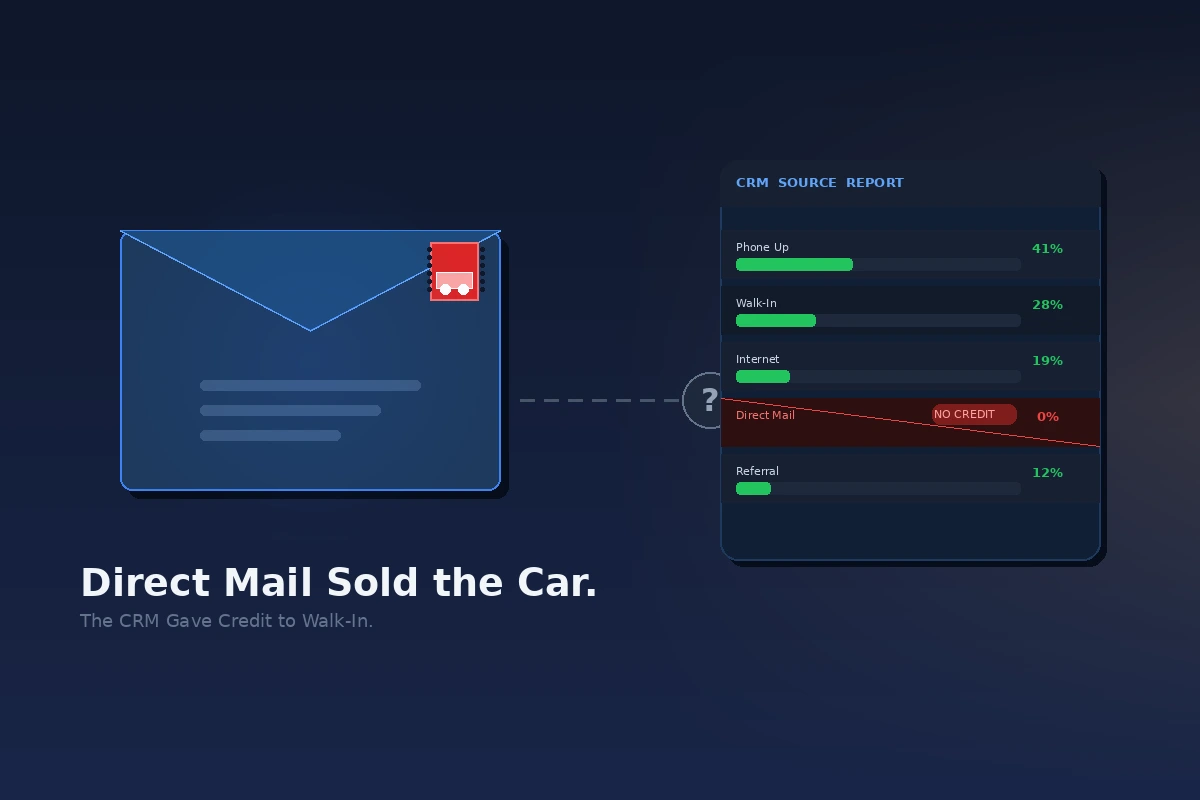
Direct mail has been a dealership marketing staple for decades. Mailers go out. Customers come in. Vehicles get sold. But somewhere between the mailbox and the CRM, the credit disappears.
The customer who received the mailer does not submit a lead form. They do not click a digital ad. They call the store, drive in, or walk into the showroom with the piece in their hand. And when the salesperson enters the opportunity, the source often gets recorded as something else entirely.
That is how a direct mail campaign can sell cars and still look invisible on a marketing report.
Direct mail does not leave a digital trail. If no one asks the customer what influenced them, the campaign never gets credit for the customers it actually created.
The Attribution Gap Is Not a Mail Problem
Many dealerships cut direct mail spending after reviewing their CRM source reports. The data appears to show that mail is not producing. Phone ups, walk-ins, and internet leads seem to be driving results instead.
But that conclusion is often wrong. The problem is not that direct mail stopped working. The problem is that the dealership stopped capturing it.
Digital channels produce trackable signals. A Facebook ad generates a click. A Google search produces a form. A marketplace listing creates a lead with a source stamp. Direct mail produces something different. It produces a customer who feels motivated to act, and that motivation rarely comes with a digital label attached.
This is where a stronger dealership marketing attribution software process becomes essential. It has to account for channels that do not create their own tracking signals.
What Happens to That Customer in the CRM
A customer receives a targeted mailer on Tuesday. They hold onto it, think about it, and call the store on Friday. The sales associate answers, has a great conversation, and books an appointment.
When that opportunity gets entered into the CRM, what source does it receive?
In most cases, it becomes a phone up. Or an unsold appointment. Or sometimes internet if the associate assumes all inbound calls come from online activity. The mailer that motivated the entire sequence gets no mention.
Multiply that across a direct mail campaign reaching thousands of households and the lost attribution adds up quickly.
Walk-Ins Are Even Harder to Trace
A customer who walks in off the street after receiving a mailer is even more difficult to attribute correctly. There is no phone call to trace. There is no digital touchpoint to reference. The customer simply arrives.
In the CRM, they become a walk-in. That is accurate as a contact method. It tells the dealership how the customer arrived. It does not tell the dealership what motivated them to make that drive.
Without asking the customer directly, that information stays invisible. The walk-in source absorbs the credit and the direct mail campaign looks like it produced nothing.
Effective automotive marketing attribution requires treating contact method and marketing influence as two separate questions, not one.
The Customer Knows What They Received
Here is the part that many dealerships overlook. The customer remembers the mailer. They may have it in their pocket. They may have left it in the car. They may have shown it to their spouse before deciding to call.
A simple question during the intake process can surface that information immediately:
Did you receive anything from us recently, or was there something specific that brought you in today?
That question takes seconds. The answer can change how an entire campaign is evaluated. It turns a walk-in or phone up into a confirmed direct mail influence, which is exactly what dealer source tracking is designed to capture.
Cutting Mail Based on Bad Data Is a Real Risk
When direct mail does not appear to produce results in a CRM report, leadership naturally questions the spend. The vendor gets blamed. The format gets questioned. The budget gets shifted to digital.
But if the real issue was attribution rather than performance, that budget shift may reduce the very influence that was quietly driving traffic and appointments all along.
Some dealerships discover this only after canceling a mail program and watching walk-in and phone traffic drop without any other obvious explanation. By then, the cost of the gap has already been paid.
Connecting Mail Influence to Gross and Sold Data
Knowing that a customer received a mailer is only the first step. The real value comes from connecting that influence to whether the customer bought, what vehicle they purchased, and what the deal looked like.
When direct mail influence is tracked through to sold customers and gross performance, dealerships can evaluate campaigns with the same rigor applied to digital spend.
That is what makes dealership ROI tracking more complete. It stops measuring only what is easy to track digitally and starts measuring what actually influenced the customer, regardless of the channel.
The Fix Is a Process, Not a Technology Swap
Capturing direct mail influence does not require a complicated overhaul. It requires a consistent habit. Sales associates need to ask the question. Managers need to reinforce it. The CRM needs a clear place to record the answer.
When that process is in place, direct mail stops disappearing from the attribution picture. The campaign either earns its credit or it does not. Either way, the decision about continuing, adjusting, or cutting the program is based on real influence rather than missing data.
That is the difference between managing a marketing budget and guessing at one.
Stop letting direct mail sell cars without getting credit.
ReferralTrace helps dealerships capture customer-reported influence from every channel, including direct mail, and connect it to real sold customers and gross performance.
Contact ReferralTrace