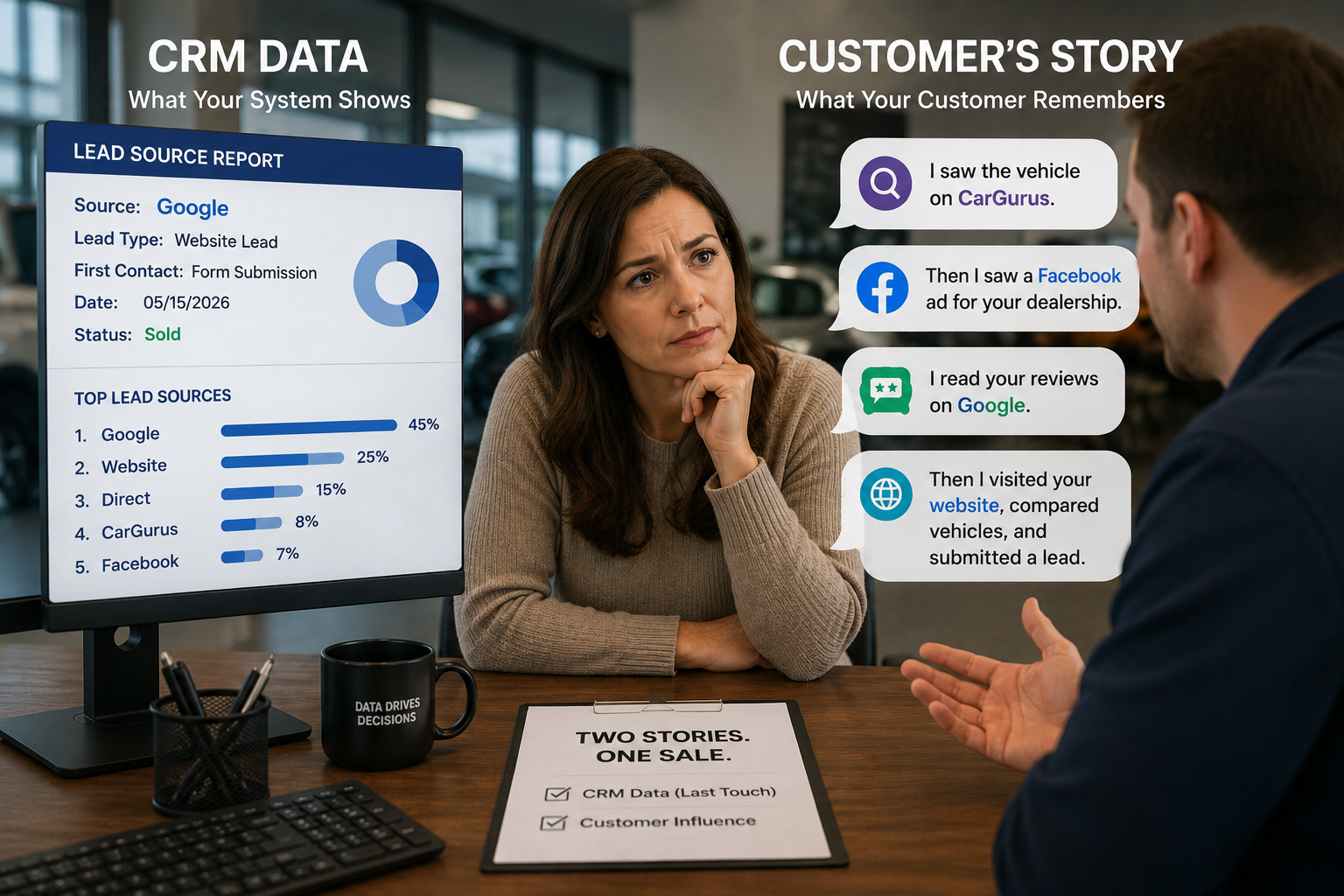
A dealership looks at its CRM report and sees that a customer came from Google. The lead source looks clean. The report looks simple. The deal gets counted as a Google lead, and everyone moves on.
Then someone asks the customer a different question. Not where the lead came from, but what helped them find the vehicle and decide to visit the dealership.
The customer says they first saw the vehicle on CarGurus. They later visited the dealership website, searched the store name on Google, and then submitted a lead.
The CRM is not always wrong. It is often just incomplete.
The CRM Tracks the Lead. The Customer Remembers the Journey.
Most dealership CRMs are built to capture lead activity. They record form submissions, phone calls, chat leads, website events, showroom visits, and source fields. That information matters, but it does not always explain what actually influenced the buyer.
A CRM may tell the dealership where the customer entered the system. The customer may tell the dealership what advertising source first created interest, built trust, or helped them choose the vehicle.
That difference is important. A lead source is not always the same thing as advertising influence.
This is where dealership marketing attribution software becomes valuable. It helps dealerships collect the customer side of the story instead of relying only on what the CRM captured.
Why the Two Stories Do Not Always Match
Car shoppers rarely move in a straight line. A customer may see a vehicle on Facebook, compare pricing on a third-party marketplace, visit the dealership website, search the dealership name, read reviews, and then call the store directly.
By the time the customer becomes a lead, the CRM may only record the final action. That final action may be accurate, but it does not show the full path that brought the customer to the dealership.
This is how one source gets credit while another source quietly influenced the sale.
Google, Website, Facebook, and Marketplace Sources Can Overlap
It is common for a dealership report to credit a sale to Google or the dealership website. That does not mean Google or the website did all the work by itself.
A customer may have discovered the vehicle on AutoTrader, remembered the dealership name, searched it on Google, and then landed on the dealership website. The CRM may show website or Google, while the customer remembers AutoTrader as the source that started the buying process.
The same can happen with Facebook, CarGurus, Cars.com, radio, direct mail, referrals, and walk-in traffic. The final source and the influential source are not always the same.
A stronger automotive marketing attribution process helps dealerships understand that overlap instead of forcing every sale into one simple source bucket.
The Risk of Trusting Only One Version of the Truth
When dealerships only trust CRM source reports, they can make decisions based on partial information. A vendor may look weak because it did not receive final source credit. A campaign may look stronger than it really is because it captured the last click.
This can lead to bad budget decisions. The dealership may cut a source that was influencing shoppers, keep a source that only captured final traffic, or misunderstand which advertising channels are helping create sold customers.
That is why dealer source tracking should include more than one data point. The CRM record matters, but the customer-reported source matters too.
The Better Question Dealerships Should Ask
Instead of only asking, "Where did this lead come from?" dealerships should also ask, "What helped influence this customer to buy from us?"
That one question changes the quality of the data. It helps uncover the advertising that created awareness, the source that helped the customer find the vehicle, and the final action that brought the customer into the CRM.
The goal is not to replace CRM reporting. The goal is to complete it.
Customer Attribution Gives Management a Clearer Picture
Dealer principals and general managers need more than lead counts. They need to know which advertising sources are connected to sold customers, front gross, back gross, and real dealership profit.
When customer-reported attribution is connected to sold deals, management can see which sources are creating real sales influence. That makes dealership ROI tracking more useful because it connects advertising influence to actual business results.
Better attribution does not create more noise. It creates better context.
Two Stories Can Become One Clear Report
The CRM story and the customer story should not fight each other. They should work together.
The CRM can show where the lead was captured. The customer can explain what advertising source influenced the purchase. Together, those two pieces of information give the dealership a much clearer view of what is really working.
That is the gap ReferralTrace is built to close. It helps dealerships collect customer-reported source influence inside the sales process so advertising decisions are based on more than the last field inside the CRM.
Find out what your customers remember, not just what your CRM captured.
ReferralTrace helps dealerships capture customer-reported source influence and connect advertising decisions to real sold customers.
Contact ReferralTrace