Every dealership loves walk-in traffic. A customer walks through the door, asks for a salesperson, looks at a vehicle, starts working numbers, and maybe buys the same day.
In the CRM, that opportunity often gets recorded as a walk-in. On the surface, that seems simple. The customer walked in, so the source becomes walk-in.
But that simple source label can hide a very expensive problem.
Walk-in is not always the source. Many times, it is only the final action after another platform influenced the customer.
The Customer Did Not Just Show Up
Most customers do not randomly appear at a dealership without seeing, hearing, searching, comparing, or thinking about something first.
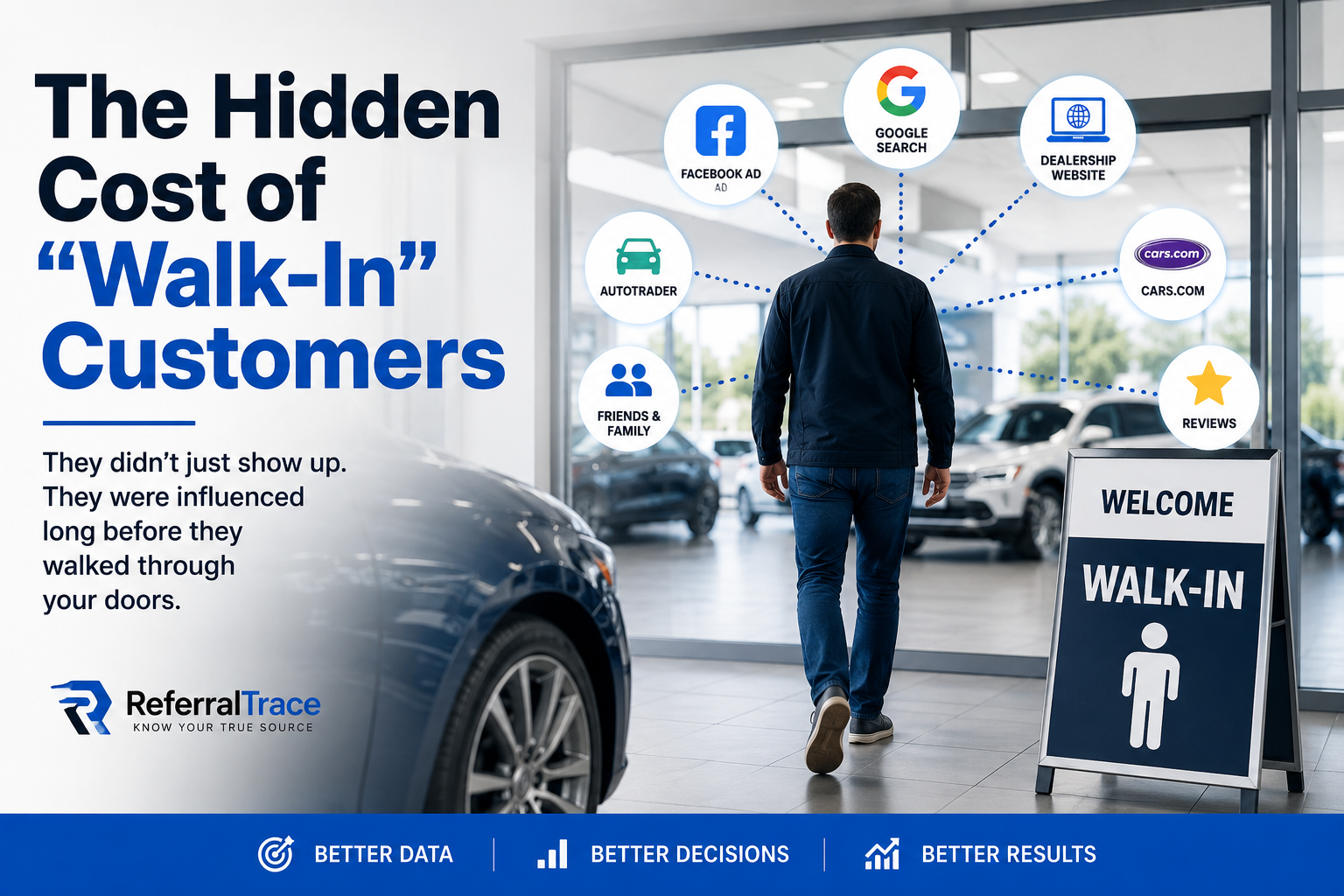
They may have seen a Facebook ad. They may have searched Google for the dealership name. They may have looked at inventory on the dealership website. They may have read reviews, checked prices, compared models, or asked a friend about the store.
By the time they walk through the door, the decision to visit may have already been shaped by multiple marketing touches.
The walk-in is the arrival method. It is not always the marketing influence that created the visit.
Why Walk-In Becomes the Default Answer
Walk-in gets used because it is easy to see. The customer is physically standing in the showroom. The salesperson knows how they arrived. The desk knows the customer is in the building. The CRM needs a source, and walk-in feels accurate.
The problem is that walk-in only explains what happened at the end of the journey. It does not explain what caused the journey.
A stronger dealership marketing attribution software process helps dealerships separate the customer arrival method from the advertising influence that happened before the visit.
The Real Influence Can Disappear
Think about a customer who sees a truck on Facebook on Monday. On Tuesday, they search the dealership on Google. On Wednesday, they visit the website and look at payments. On Thursday, they compare similar trucks on a marketplace. On Friday, they drive to the dealership and buy.
If the deal is recorded only as walk-in, every influence before the showroom visit disappears from the report.
Facebook does not get credit. Google does not get credit. The dealership website does not get credit. The marketplace does not get credit. The report only says walk-in.
That missing information can quietly damage how management understands advertising performance.
Walk-In Is a Contact Method, Not Always a Marketing Source
This is the distinction that matters. Walk-in often describes how the customer made contact with the dealership. It does not always describe why the customer chose that dealership.
Those are two different questions.
The contact method may be walk-in. The influence may be Facebook, Google, the dealership website, a third-party marketplace, a referral, a previous customer, a direct mail piece, a service visit, a radio spot, or a reputation search.
When those two ideas get mixed together, the dealership may end up with clean-looking reports that are not telling the full truth.
The Hidden Cost Is Bad Budget Decisions
The cost of mislabeled walk-ins is not just bad data. The real cost shows up when management starts making budget decisions based on incomplete reports.
If the CRM shows a large number of sold customers coming from walk-ins, a Dealer Principal or General Manager may believe advertising is not carrying as much weight as it really is.
They may look at the report and think the store is winning because of location, repeat business, brand strength, or showroom traffic alone.
But the better question is this: what influenced those customers before they walked in?
Without that answer, a dealership may cut the very campaigns that created the visit.
Marketing Can Create the Visit Without Getting Credit
Not every customer submits a lead. Not every customer clicks a button. Not every customer fills out a form. Some customers research quietly and then arrive in person.
That does not mean marketing failed. In many cases, it means marketing worked without leaving an obvious CRM trail.
A customer may watch a vehicle video, check the price, view photos, read reviews, and then decide the store is worth visiting. If they walk in instead of submitting a lead, the advertising influence may never appear in the CRM.
This is why automotive marketing attribution has to look beyond basic lead-source labels.
Salespeople Are Focused on the Sale
This problem does not usually happen because someone is trying to hide information. Most sales associates are focused on helping the customer, finding the vehicle, getting keys, answering questions, handling trade information, and moving the deal forward.
In a busy showroom, asking what influenced the customer to visit may not happen. The opportunity gets entered as walk-in, and everyone moves on.
The sale may still happen. The customer may still be happy. The dealership may still make money. But the advertising influence behind that sale may be lost forever.
Walk-In Reports Can Make Strong Marketing Look Weak
When too many sold customers are marked as walk-ins, marketing reports can become misleading. A campaign may look weak because customers did not submit digital leads. A website may look less important because customers visited in person. A marketplace may look less valuable because the customer never clicked the lead button.
But the campaign, website, marketplace, or search activity may still have influenced the sale.
The problem is not always the marketing. Sometimes the problem is that the dealership is only tracking the final action instead of the full customer influence.
Customer-Reported Influence Fills the Missing Gap
The customer usually knows what influenced them. They may remember seeing a specific vehicle online. They may remember searching the dealership. They may remember a Facebook ad, a Google review, a website visit, a friend, or a previous experience with the store.
A simple question can unlock the information:
What influenced you to visit us today?
That question does not slow down the deal. It does not replace the CRM. It adds a missing layer of truth to the CRM data.
This is where dealer source tracking becomes valuable. It helps capture the influence behind the visit instead of stopping at the arrival method.
The Difference Between Traffic and Influence
Dealerships often measure traffic. They count showroom visits, phone calls, internet leads, chats, appointments, and sold customers.
But traffic does not always explain influence.
A customer walking in tells you where the customer ended up. It does not automatically tell you what moved that customer from interest to action.
Influence is what shaped the customer before they arrived. It is the ad, search, referral, review, website visit, or marketplace listing that helped create confidence.
Better source tracking helps connect that influence to real sold customers.
Connecting Walk-Ins to Sold Customer Performance
The most important question is not only how many customers walked in. The better question is which influences created profitable sold customers.
When a dealership can connect customer-reported influence to sold units, front gross, back gross, total gross, ZIP code, vehicle type, and salesperson performance, the data becomes far more useful.
That is what makes dealership ROI tracking more powerful. It moves reporting away from simple activity counts and toward real business results.
Better Data Protects the Marketing Budget
A Dealer Principal does not want to cut a campaign that is quietly producing showroom traffic. A General Manager does not want to cancel a platform that is influencing profitable walk-in customers. A marketing manager does not want to defend a budget with incomplete data.
Better attribution helps everyone make stronger decisions.
It shows which channels influence customers before they arrive, which sources are tied to sold deals, and which investments are helping create real dealership revenue.
Walk-Ins Still Matter
None of this means walk-ins are bad. Walk-in traffic is valuable. A customer who arrives in person is often serious, engaged, and closer to making a decision.
The issue is not the walk-in itself. The issue is treating walk-in as the full source story.
The dealership should still know the customer walked in. But it should also know what influenced that customer to walk in.
That is the difference between recording the visit and understanding the journey.
The Real Hidden Cost
The hidden cost of walk-in customers is not the customer. The customer is valuable. The hidden cost is the missing influence data behind that customer.
When that influence is not captured, the dealership may misunderstand its advertising, misread its reports, and misallocate its budget.
A customer may have walked in, but they were likely influenced long before they opened the showroom door.
Dealerships that understand that difference can make better marketing decisions, protect stronger campaigns, and get a clearer picture of what is truly driving sold customers.
Stop letting walk-ins hide your real marketing influence.
ReferralTrace helps dealerships capture customer-reported source influence and connect it to real sold customers.
Contact ReferralTrace