Dealerships spend thousands of dollars every month on advertising. Search, social media, third-party listings, marketplace sites, radio, email, direct mail, and website tools all compete for budget. Every vendor wants credit. Every report claims to show performance.
But when it comes time to decide what is really working, many dealerships are still looking at the wrong version of ROI. They look at clicks, impressions, leads, cost per lead, and CRM source reports. Those numbers matter, but they do not always answer the question management really cares about.
Which advertising sources helped create sold customers and real gross profit?
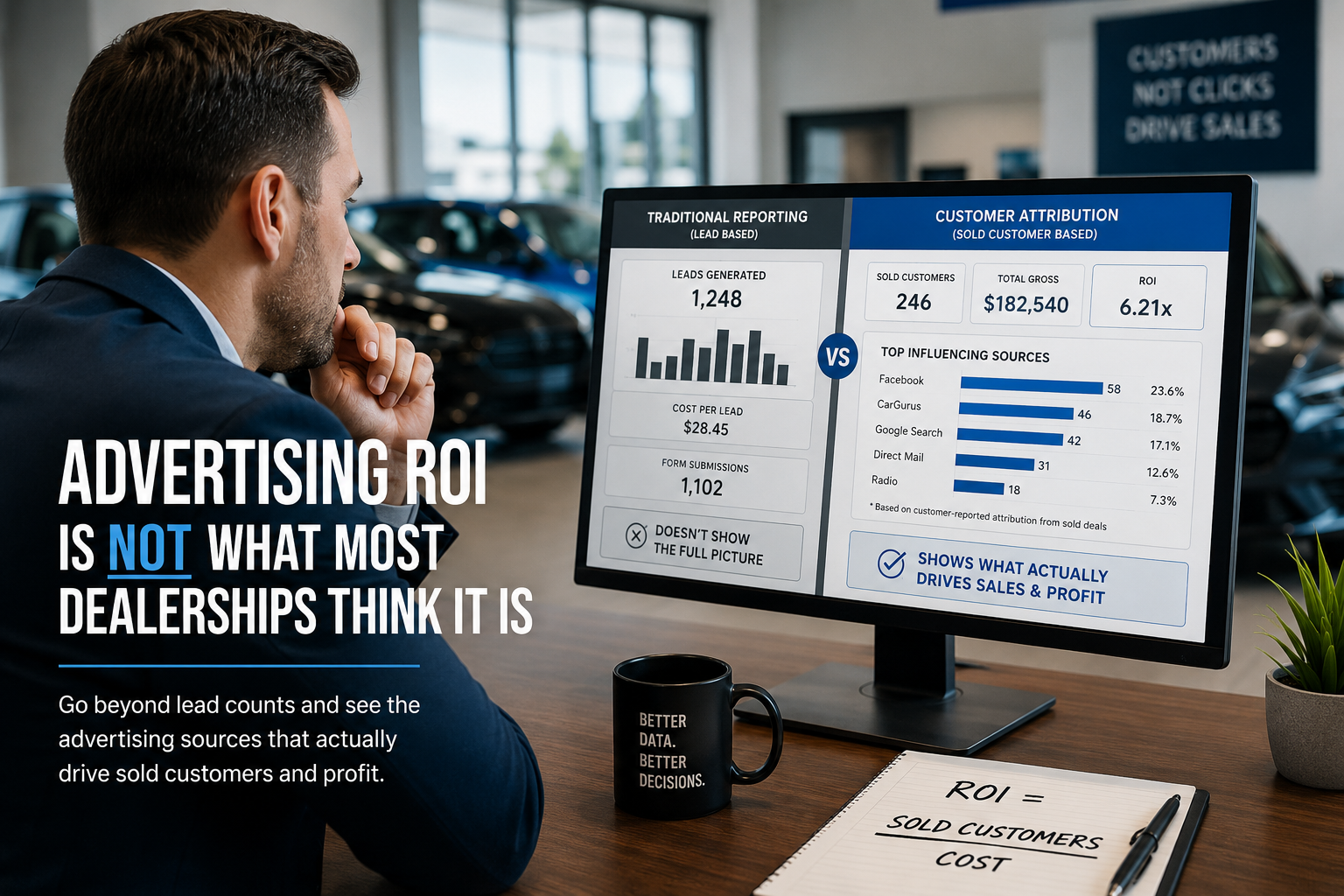
Advertising ROI is not just what generated a lead. It is what helped create a sale.
Lead Counts Are Not the Same as ROI
A campaign can generate a large number of leads and still produce weak sales results. Another campaign can create fewer leads but influence buyers who actually purchase vehicles. If the dealership only compares lead volume, the better-performing source may look weaker on paper.
This is one of the most common problems in dealership marketing reports. The store sees lead count as the main measurement of success, even though the final goal is not more leads. The final goal is more profitable sold customers.
Good dealership ROI tracking should connect marketing sources to sales outcomes, not just lead activity.
The CRM Can Miss Advertising Influence
Your CRM may show where the lead entered the system, but it may not show what influenced the customer before that. A shopper might see a vehicle on Facebook, compare it on a third-party marketplace, search the dealership name on Google, visit the website, and then submit a form.
The CRM may credit the website or Google because that was the final action. That does not mean Facebook or the marketplace did not influence the sale. It only means the CRM captured the final step.
This is why last-source reporting can be dangerous when used by itself. It can make some sources look stronger than they really are and make other sources look weaker than they really are.
Real ROI Should Follow Sold Customers
Dealerships do not deposit leads into the bank. They deposit revenue from vehicle sales, finance, service, and long-term customer relationships. That means ROI should be connected to sold customer data whenever possible.
A stronger attribution process looks at more than the first report. It connects advertising influence to sold deals, front gross, back gross, total gross, customer location, and buying behavior.
This gives dealer principals, general managers, and marketing teams a better view of what advertising is actually helping the store sell cars.
Customer-Reported Attribution Adds the Missing Layer
Customers often remember the source that helped them find the vehicle or decide to visit the store. They may say they first saw the vehicle on CarGurus, Facebook, AutoTrader, Cars.com, a Google search, a referral, or a radio ad.
That customer answer does not replace the CRM. It completes the CRM. The CRM shows what was captured digitally. The customer explains what influenced the buying journey.
This is where dealership marketing attribution software can help. It gives the dealership a way to collect source influence from sold customers instead of relying only on the final lead source field.
Why This Matters When Reviewing Vendors
Vendor decisions are often made from incomplete data. A third-party listing provider may look weak in the CRM because customers later searched the dealership name and submitted a website lead. A social campaign may look weak because it created awareness but did not receive final source credit.
Without customer attribution, the dealership may cancel a vendor that was influencing real buyers. Or it may keep spending money on a channel that captures leads but does not create profitable sales.
Better dealer source tracking helps management separate lead capture from true sales influence.
Advertising ROI Needs Context
A source that generates ten sold customers with strong gross may be more valuable than a source that generates one hundred weak leads. A campaign that influences repeatable, profitable buyers may deserve more attention than a campaign that simply fills the CRM with activity.
ROI is not just about how many people clicked. It is about what happened after the click. Did the customer buy? Did the deal make money? Did the advertising source help bring in the right customer?
That is the difference between basic reporting and true automotive marketing attribution.
The Better Way to Measure Dealership Advertising
Dealerships should still review leads, website traffic, calls, form fills, and CRM source reports. Those numbers are useful. But they should not be the only numbers used to judge advertising performance.
The better approach is to combine CRM data with customer-reported source influence and sold deal performance. That gives the dealership a more complete picture of what is really working.
When the store can see which advertising sources are connected to sold customers and gross profit, marketing decisions become clearer. Budgets become smarter. Vendor conversations become more honest. And management can stop guessing based on partial reports.
True ROI Starts After the Sale
Advertising ROI should not stop at the lead. It should follow the customer all the way to the sold deal. That is where the real value is found.
ReferralTrace is built around that idea. It helps dealerships capture customer-reported attribution during the sales process and connect that information to real sold customer outcomes.
Because the dealership does not need another report full of noise. It needs a clearer answer to one important question: which advertising actually helped us sell more cars?
Measure advertising by sold customers, not just lead activity.
ReferralTrace helps dealerships capture customer-reported source influence and connect advertising decisions to real sales performance.
Contact ReferralTrace